Solution Focused Justice 2026

A Cross-Jurisdictional Symposium – Held 20 and 21 February 2026
About the symposium
On 20 and 21 February 2026, the Bugmy Bar Book, the NSW Bar Association, Te Kura Kaiwhakawā (New Zealand Institute of Judicial Studies) and the University of Technology, Sydney, hosted a symposium on solution focused courts. The event was supported by the NSW Judicial Commission and the Australasian Institute of Judicial Administration.
The symposium showcased the way in which solution focused justice operates in Australia and New Zealand, highlighted examples of best practice and fostered connections between judicial officers, legal professionals, academics, students, and community organisations committed to trauma-informed, culturally safe and solution focused justice.
What are solution-focused courts?
Solution-focused courts (sometimes referred to as specialist or problem solving courts) are specialised court programs designed to address the root causes of why the person before the court has committed a criminal offence by identifying and focusing on supporting the person’s mental health, substance dependence or experience of family violence.
Solution focused justice can also be applied to mainstream courts to enhance the courts responsiveness to issues underlying crime and improve the quality of the justice process.
The symposium lives on
Eucation & Resources
Visit the Education, Links and Resources page for information about related events and shared resources.
This page continues to be updated as we receive new resources.
Courts in Action
Last but not least, you can view inspiring examples of solution-focussed justice within in Australia and New Zealand showcased on our Courts In Action page.
We encourage participants to continue to send information about activities and solution-focussed justice. Submission guides for presentations and videos are available within the links and resources page.
The next symposium will be held early in 2028. Sign up to our newsletter to be notified of this and other Bugmy Bar Book events, new chapters and news.
Statement of Principles
The following principles have been developed by the Symposium Planning Committee
Recognising that justice systems must operate not only as instruments of accountability but as places to encourage and foster rehabilitation, reconciliation, and social cohesion,
Affirming the inherent dignity and equal rights of all persons, including complainants, victims, witnesses, accused persons, offenders, and communities,
Accepting the Universal Declaration of Human Rights, the International Covenant on Civil and Political Rights, and the United Nations Basic Principles on the Use of Restorative Justice Programmes and the United Nations Declaration of Rights of Indigenous Peoples,
Confirming the importance of research, expert opinions and evidence which overwhelmingly supports the need for the criminal justice systems to identify and address the causes of crime on an individualised basis,
Acknowledging the unique role of First Nations, local, and culturally grounded practices in fostering restorative and therapeutic justice,
Advancing legal frameworks and processes that heal harm and trauma, reduce recidivism, strengthen the social and emotional wellbeing of individuals, families and communities,
In recognition of the right of all individuals to justice systems that promote human dignity, healing, and harmony,
The participants in the 2026 Solution Focused Justice Symposium adopt and recommend the following principles for solution focused, therapeutic and restorative approaches to justice as a guide to governments, judicial institutions, communities, and individuals:
Article 1: Dignity and respect
All persons shall be treated with dignity, compassion, and cultural respect throughout every stage of the justice process.
Article 2: Voluntariness and consentcle 1: Dignity and respect
Participation in solution focused, therapeutic and restorative justice mechanisms shall be based on the informed, voluntary, and ongoing consent of all parties involved.
Article 3: Participation and empowerment
Mechanisms shall empower individuals, families and communities through active participation, dialogue, and shared decision-making.
Article 4: Holistic well-being1: Dignity and respect
Outcomes shall prioritise the mental, emotional, physical, cultural, social and spiritual well-being of individuals, families and communities.
Article 5: Accountability through rehabilitation, restorative processes and healing
Accountability shall be framed not solely through punishment but through acknowledgement that accountability includes reparation of harm and meaningful engagement to rehabilitate and engagement in restorative processes.
Article 6: Inclusivity and non-discrimination
Therapeutic justice programs shall be accessible and inclusive, without discrimination on the basis of race, gender, age, ability, culture, or status.
Article 7: Respect for culture and embracing local knowledge and solutions
Justice processes shall recognise and incorporate First Nations peoples and their culture, voices, customs, traditions, and healing practices within solution focused, therapeutic and restorative justice mechanisms.
Article 8: Restoration
Justice approaches shall focus on restoring and strengthening relationships of individuals with their families and communities.
Article 9: Capacity building and resources
At a Federal and State level, governments and institutions shall ensure sufficient resources, training and support to uphold the integrity and sustainability of solution focused, therapeutic and restorative approaches to justice. This includes supporting the capacity of First Nations controlled organisations to design and deliver support services to First Nations people. Government support shall extend to regional and remote communities.
Article 10: Support for judicial officers and others working within justice systems
Judicial officers should be supported and provided training to be equipped to practice and conduct their courts in a trauma informed and culturally safe way. That support and education should also extend to members of the legal profession and other services involved in the criminal justice system.
Judicial officers should be supported to improve the information available to them to inform judicial decision making. This includes information about:
a. the unique and systemic historic, social and political context impacting First Nations people;
b. the impacts of adverse experiences including trauma, socioeconomic inequality and structural disadvantage;
c. being mindful of avoiding a deficit narrative and actively considering the strengths of individuals, families and communities; and
d. the role of community supports, family and culture as protective factors.
Article 11: Evaluation
Solution focused, therapeutic and restorative justice initiatives should be subject to ongoing evaluation, learning, and refinement in collaboration with affected communities and stakeholders. Evaluations should be carefully designed so as to identify the range of potential benefits associated with solution-focused justice, including qualitative outcomes, and to ensure those outcomes are appropriately captured in evaluations.
Article 12: Connection and future
The participants of the symposium support fostering relationships between participating jurisdictions including joint initiatives to share learning and experiences which support these principles. The participants support the next solution focused justice symposium being held in 2028.
Cultural Safety
Cultural safety is the firelight where First Nations stories are told,
where our wounds are acknowledged, not dismissed,
where history is not a distant shadow but the sacred ground we walk upon.
It is not just about theorising our pain,
but feeling the weight of our ancestors in the silence,
in the pauses between our words,
in the way we sit, how we breathe, how we watch the world.
Cultural safety is not a checklist, not a policy, not a footnote.
It is the pulse of justice itself
the difference between a space that holds us
and a space that consumes us.
For far too long, the law has been a cold room,
where we shrink beneath its towering walls,
where our tongues are foreign in our own lands,
where our truths are measured against rules
that were never written for us,
only against us.
The Significance of Culture report speaks of this
how trauma does not fade but accumulates,
passed down like a birthright no one asked for,
how our stories of survival are used against us,
how the system sees our struggle as our failure,
never its own.
The Little Children are Sacred report was a warning,
a cry that was met with chains instead of care,
intervention instead of understanding,
control instead of compassion.
It showed that cultural safety is not just about justice in the courts
it is about justice in the home, in the school, in the hospital,
in every space where our people exist.
So, to those who stand in the halls of power,
who hold the pens that can wound or heal
cultural safety means you do not come as a saviour, but as a listener.
You do not assume, you do not impose,
you do not reshape our truths to fit your world.
Instead, you sit with us in the truth of our history,
you unlearn what you thought you knew,
you do not stand in front, you stand beside us,
until justice is not something we plead for
but something that is finally, rightfully, ours.
Keith Quayle (Bakindji)
About the Artwork
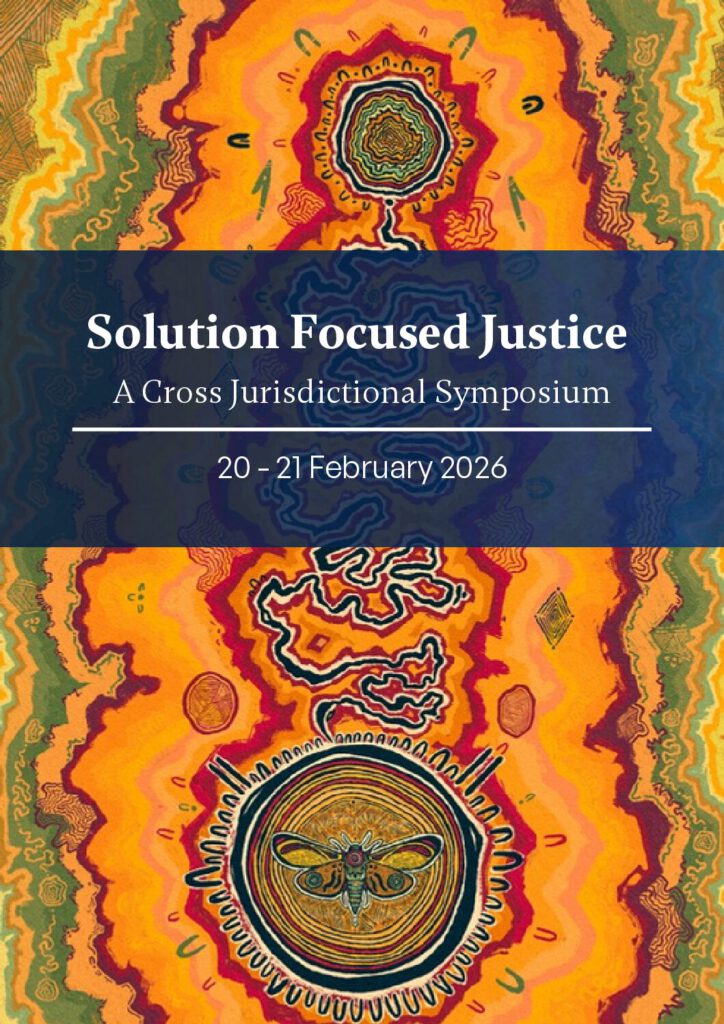
This artwork is a representation of the life cycle of the Squiggly Gum Moth and Larvae. The artwork takes place on a Gum tree bark face, each colour representing a layer. The larvae of the Squiggly moth burrows into the tree and consumes the fresh inner layer of the tree bark forming intricate linework (black lines), reminiscent of a bus trail or river system. I wanted the Larve to represent the journey that you all are taking, or have already taken, to reach your meeting place (circle lifework). I also believe that the larvae undertaking of eating, moving and growth is reminiscent of the undertaking someone must endure when dealing with mental health.
The outcome of this journey is a period of great change where the larvae stops its journey and breaks down into a moth through metamorphosis, its final burrowing out of the tree and into the world, free to fly and unbound from its original path. As you all converge on this place and share knowledge, you take those learnings to your homes and help others with them, similar to the moths path.
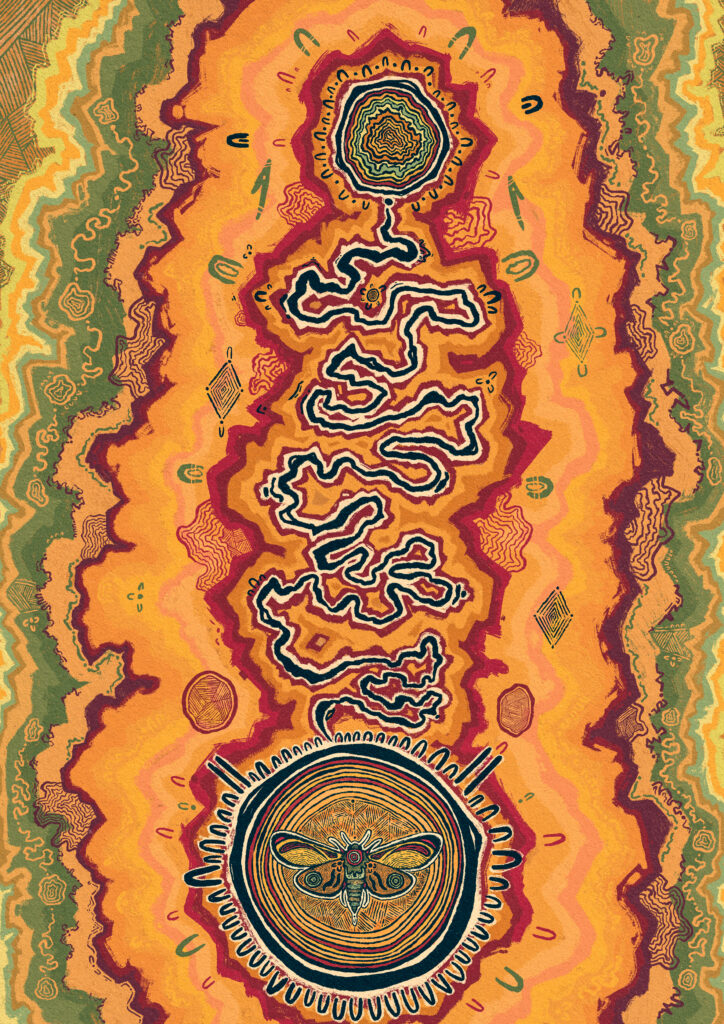
Artwork © 2026 Jeremy Worrall (Wright)
Jeremy Worrall Biography
Jeremy Worrall (Wright) is a Gomeroii/Ngarabal man living on Gadigal land. Jeremy creates artworks that blend modern styles with traditional linework. He also works on multimedia animations. Jeremy was shortlisted for the Ena Noël Award for his illustration of Etta and the Shadow Taboo in 2025, and was the wonder created the illustrations for Etta and the Shadow Taboo and won the 2025 National NAIDOC Week Poster Competition with an artwork titled Ancestral Lines.
Sponsors
The organisers of the symposium are very grateful to our sponsors who have contributed to this event.